

01
Commitment
We honour our promises to users and to each other.
Integrity: clear promises, honest trade-offs, traceable decisions, and truth-telling when reality shifts.
Operating framework
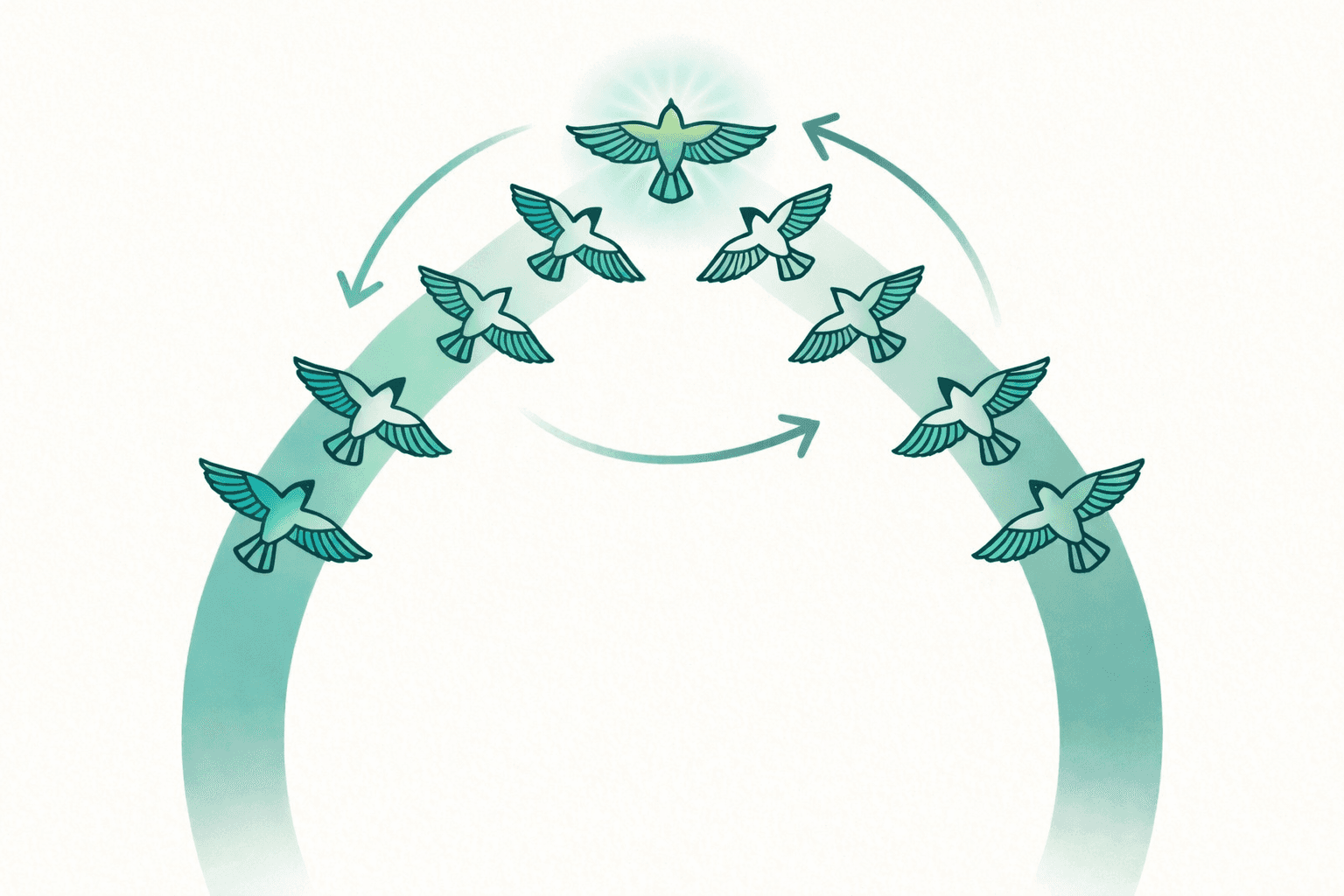
Formation Leadership for Outcomes, Care and Knowledge. FLOCK gives teams a shared language for how work is led under pressure, a repeatable improvement cycle with evidence discipline, and a governance bridge so leaders can unblock decisions when things go wrong.
Why FLOCK exists
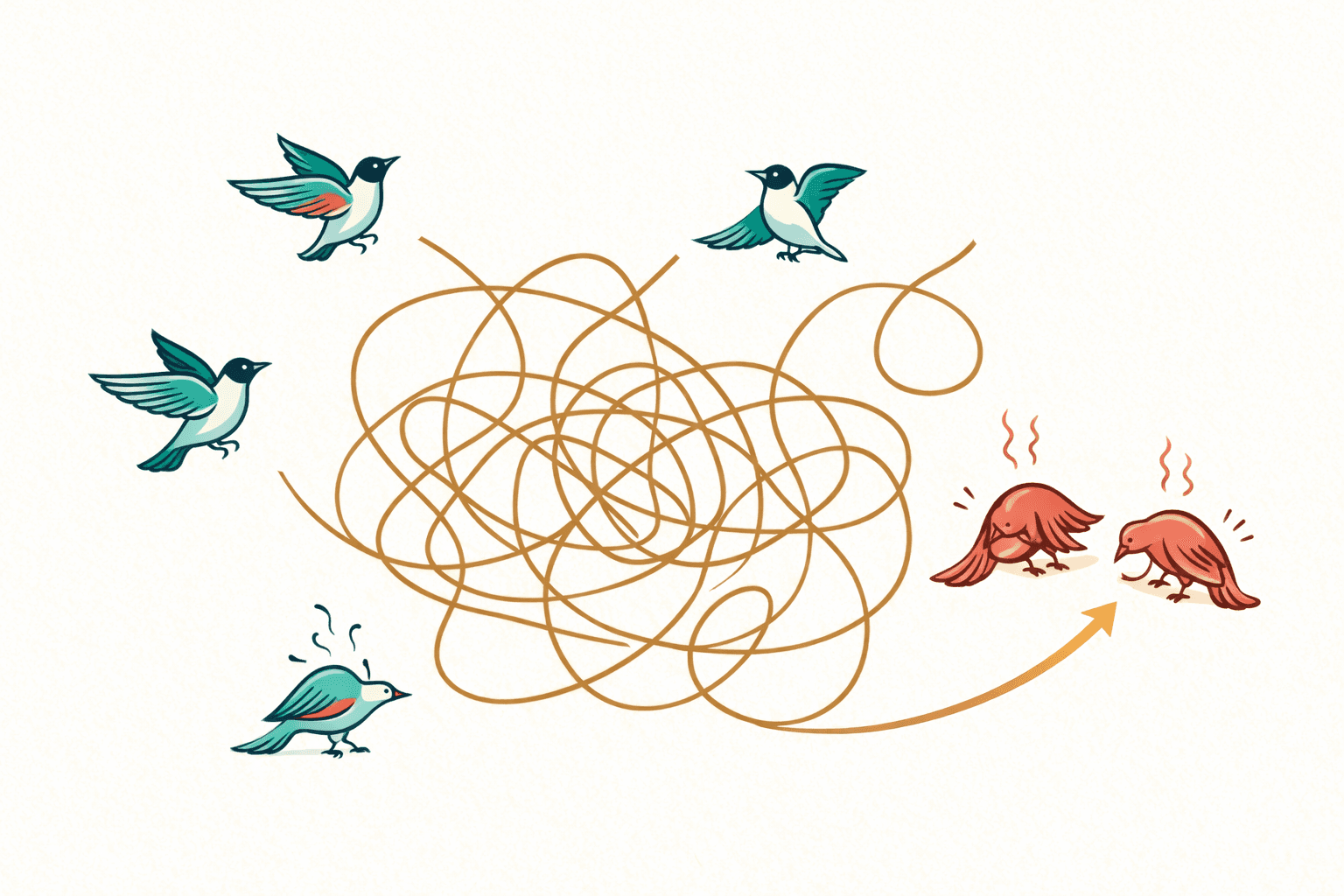
Over 15 years working inside multidisciplinary teams across public and private sector services, the same failure patterns appear regardless of programme or team size.
FLOCK exists to prevent those patterns by making leadership practice visible, assessable, and improvable.
The core idea
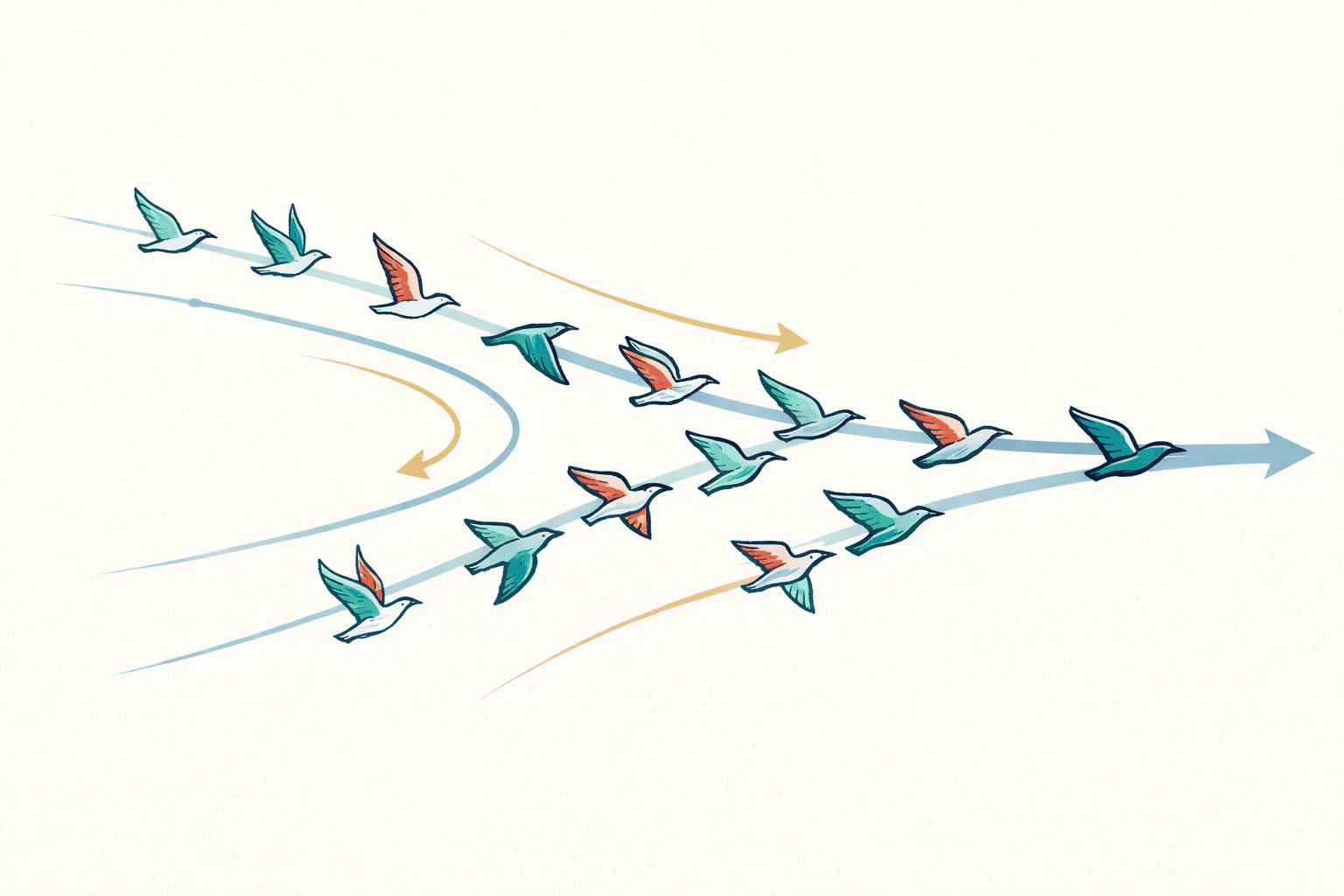
Healthy teams do not rely on heroes. They fly in formation.
Five principles
Each principle is a leadership outcome the team protects. Not an aspiration but an observable standard you can see in how work gets done.
01
We honour our promises to users and to each other.
Integrity: clear promises, honest trade-offs, traceable decisions, and truth-telling when reality shifts.
02
We look after the wellbeing and growth of the whole team.
Care as a system property, not an individual act. This extends to designing services that are genuinely inclusive for all users.
03
We align around a clear direction and move as one.
One coherent story of users, problems, and outcomes that everyone on the team can tell, consistently.
04
We share responsibility, visibility, and decision-making.
Leadership rotates. Deputies are real. The service can keep flying if one person steps away.
05
We manage our pace so people and services can last.
Crunch is exceptional, time-boxed, and followed by recovery. Permanent emergency mode is a planning failure, not a badge of honour.
How it works
Evidence is referenced, not stored. The goal is credible judgement and a small improvement plan that gets done, not perfect documentation.
Seven stages per cycle
What a cycle produces
GDS assessment
If your team is running FLOCK properly, you arrive at every GDS assessment gate already prepared. Panels look for three things: a coherent narrative, honest failure evidence, and decision traceability. All three are built continuously through the cycle.
At cycle start
Which Service Standard points are non-negotiable for this cycle, set explicitly rather than discovered retrospectively.
Throughout
Maintained continuously, not constructed in the final week. Panels look for honest evidence of learning. This is where it lives.
Every 6–8 weeks
Every Progress Update includes the assessment story, so teams practise it regularly rather than rehearsing once before the panel.
Framework documents
FLOCK is a complete, versioned framework. Everything a team needs to adopt it, run it, and demonstrate it to governance.
Core framework
Five principles, role mapping, the 90-day adoption guide, governance handshake, delivery lifecycle view, and GOV.UK Service Standard crosswalk.
For all readers.
Structured cycle
How to run an improvement cycle with scoring, evidence discipline, and independent review built in from the start.
For cycle owners and reviewers.
14 working templates
Decision log, risk log, evidence index, progress update, self-assessment worksheet, improvement plan, failure and learning log, and more.
GDS alignment
Service Standard mapping by phase, a three-session preparation process, mock panel question sets, and day-of guidance.
For teams facing assessment gates.
Worked example
Two complete FLOCK cycles shown in full: a Discovery cycle and a Beta cycle, with all artefacts and governance updates.
For teams new to the framework.
In practice
FLOCK is not a theoretical framework. Elements of it are actively informing delivery on the MHCLG WebCAF Alpha, a complex public sector programme with multiple stakeholders, a fixed assessment timeline, and significant accessibility obligations.

Get started
FLOCK is designed to be adopted incrementally. Pick one service or team, run three core rituals for 4–6 weeks, focus on one or two principles, and route a one-page Progress Update through your governance forum. Most teams find that is enough to establish whether FLOCK is useful in their context.